


Guide to Reading & Understanding Financial Statements
Do you understand the financial health of your company?
8/7/20254 min read


Financial statements are essential reports that businesses, whether SMEs, family-owned enterprises, or large corporations use to track and communicate their financial health and operational performance. In Kuwait’s dynamic economic environment, where sectors such as oil & gas, real estate, retail and finance play significant roles, comprehending financial reports is not merely an accounting requirement, it's a strategic advantage.
This step-by-step financial statement guide offers a comprehensive look at the four main types of financial reports, with special relevance for Kuwaiti business owners, executives, and investors. Mastering the basics of financial reporting helps in better decision-making, improved cash flow management and long-term sustainability. It also ensures compliance with local regulations set by the Ministry of Commerce and Industry (MOCI), Capital Markets Authority (CMA), and Kuwait Direct Investment Promotion Authority (KDIPA), among others.
A balance sheet presents the book value of a company, offering a snapshot of its assets, liabilities, and shareholders' equity at a specific date. Balance sheet analysis helps stakeholders determine liquidity, solvency, and capital structure and provides insights into the company's current financial health, crucial for business analysis and investment decisions. Instead of forecasting future performance or trends, the balance sheet provides a clear view of the company's financial position at a specific point in time.
Blog Author: Jericca Merryl
Accountant at Alkhuzam Co - an Independent Member of Morison Global
4. Statement of Shareholders' Equity
3. Cash Flow Statement
A company's cash flow statement (CFS) details cash inflows and outflows during a specific period. It helps stakeholders understand how cash is generated and spent, highlighting financial sustainability. Cash flow statement breakdown is critical for understanding liquidity and ensuring a business can meet obligations and fund growth. CFS is an essential tool in corporate finance that shows whether a business can support ongoing and future operations effectively.
The statement of shareholders’ equity outlines changes in equity value over an accounting period. It supports the balance sheet and helps investors evaluate profitability. This key document in financial reporting tracks retained earnings, issued shares, and other equity movements critical for stakeholders.
Final Thoughts
Kindly reach us on:
info@alkhuzam.com | +965 22414000 | +965 66162610
Located at: KIPCO Tower, Sharq, Kuwait
2. Income Statement (Profit & Loss Statement)
An income statement or profit and loss (P&L) statement outlines a company's revenues, expenses, gains and losses over a specific period. It highlights the business’s profitability, cost management, and revenue generation, which are key factors for financial performance analysis and essential for entrepreneurs, investors and stakeholders evaluating business success. This income statement guide helps business owners and investors evaluate performance and detect inefficiencies.
Key Components of Income Statements:
Revenue Total income from product sales or services provided.
Cost of Goods Sold (COGS): Direct costs involved in manufacturing or delivering goods.
Gross Profit: Revenue minus COGS, showing core profitability.
Operating Expenses: Ongoing business costs including rent, salaries, and utilities to run the company.
Net Income: Final profit after deducting all expenses and taxes, a vital metric for financial reporting and business performance analysis.
Our Financial Advisory Success Story in Kuwait
On providing financial advisory and accounting services to a client operating in Kuwait’s Confectionary industry, we identified a critical operational challenge: inefficient inventory management. The client’s practice of bulk purchasing with upfront payments was not aligned with their monthly production cycle or their profit and loss margins, leading to cash flow strain. This mismatch was particularly problematic in a market like Kuwait, where seasonal demand fluctuations, especially around Ramadan, Eid, and National Holidays impact production planning and inventory turnover.
To address this, we implemented a tailored inventory tracking and valuation system that provided real-time visibility into stock levels, expiry risks, and production alignment. Additionally, we ensured accurate cost allocation, allowing for more precise margin analysis and pricing decisions.
As part of our CFO consulting and corporate finance strategy approach our team at AlKhuzam & Co. conducted a strategic business review, focusing on key performance indicators (KPIs) and leveraging both financial and operational data. This allowed us to deliver actionable insights that enhanced the client’s economic efficiency, improved decision-making, and supported sustainable growth in a competitive and quality-sensitive market like Kuwait.
This is a prime example of how business financial planning, financial risk assessment, and growth consulting can be used to deliver measurable results for businesses in Kuwait. By integrating corporate finance insights with on-the-ground operational realities, we helped our client not only improve internal processes but also strengthen their strategic position in a niche yet highly seasonal sector of the Kuwaiti market.
Get in touch with our experienced accountants and financial advisors at AlKhuzam & Co. Whether you need help with financial planning, reporting, compliance, or understanding company financials, we’re here to guide you every step of the way.
📬 Stay Updated
Subscribe to our newsletter or follow us on LinkedIn to get the latest posts, regulatory updates, and expert insights on doing business in Kuwait.
@alkhuzamco
Analyzing financial reports offers valuable insights into a company’s profitability, cash flow, and operational performance. It enables business leaders to detect financial trends, address issues proactively and make informed decisions. A proper understanding of financial statements is essential for strategic planning and sustainable business growth.
By tracking financial data, businesses can:
Identify areas of overspending or underperformance.
Make informed strategic choices such as hiring, expansion, or investment.
Enhance budgeting accuracy for future planning.
Boost investor trust through transparent financial reporting and reliable business insights.
Knowing how to read financial statements is a valuable first step toward financial literacy. Monitoring the right financial metrics such as gross margins, operating cash flows, return on equity, and debt ratios allows Kuwaiti businesses to adapt in a competitive and often fluctuating market environment. Whether navigating subsidy reforms, regional expansion, or foreign investment opportunities, a solid grasp of financial statements explained through this guide can empower your decision-making process.
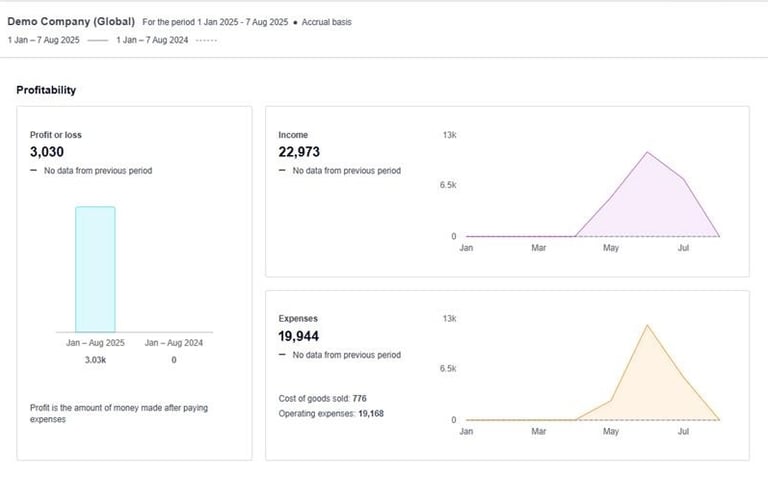
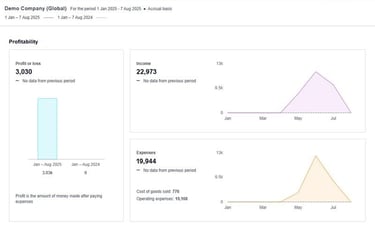
Disclaimer: The image illustration shown above is based on the Xero Demo Company & is for demonstration purposes only. It does not contain or represent any real client data.
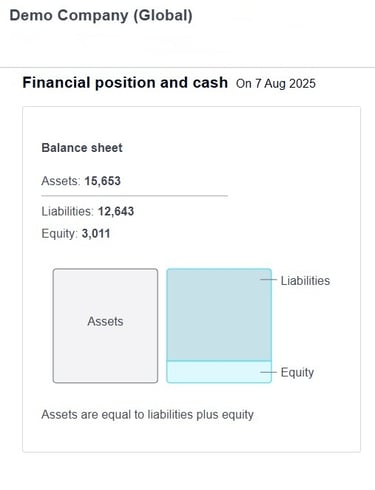
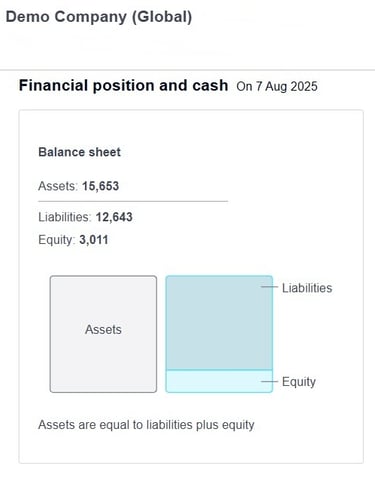
Disclaimer: The image illustration shown above is based on the Xero Demo Company & is for demonstration purposes only. It does not contain or represent any real client data.
1. Balance Sheet
Subscribe to our Newsletter & never miss another update!
©2026 Alkhuzam Co | An Independent Member of Morison Global | All rights reserved.
Alkhuzam & Co
We Sell Specialism
Address
Working Hours
9AM - 5PM
(Sun-Thurs)